
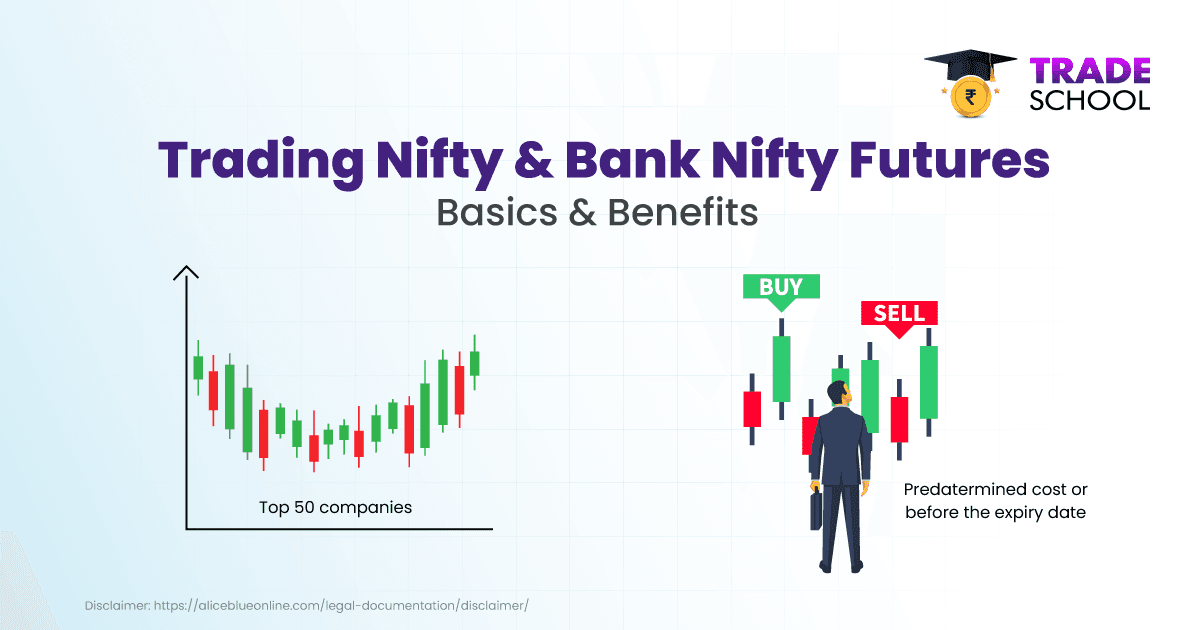
Trading Nifty and Bank Nifty futures allows investors to speculate on index movements or hedge portfolio risks. These contracts offer high liquidity, leverage, and exposure to top stocks in one trade, making them popular tools for active traders seeking short-term opportunities or risk control.
Understanding Nifty And Bank Nifty Futures
Understanding Nifty and Bank Nifty futures involves knowing that they are contracts that track the Nifty 50 and Bank Nifty indices. These futures let traders profit from market movements or hedge positions by predicting future price directions with margin-based trading and built-in leverage.
What Are Index Futures?
Index futures are derivative contracts that allow traders to buy or sell a stock market index at a set price on a future date. They help speculate on index movements or hedge portfolios against market fluctuations without owning individual stocks.
Why Is Index Futures Important?
Index futures are important because they provide liquidity, price discovery, and hedging tools for investors. They enable traders to manage risk efficiently, take directional views on the market, and protect long-term investments during volatile market conditions using a cost-effective and flexible approach.
Difference Between Nifty Futures And Bank Nifty Futures
The main difference between Nifty futures and Bank Nifty futures lies in their underlying indices. Nifty futures track the Nifty 50 index, representing diversified sectors, while Bank Nifty futures focus only on banking stocks, offering higher volatility and sector-specific trading opportunities for active traders.
| Feature | Nifty Futures | Bank Nifty Futures |
| Underlying Index | Nifty 50 (Top 50 companies across various sectors) | Bank Nifty (Top banking sector companies) |
| Sector Coverage | Broad, diversified across multiple sectors | Focused only on the banking sector |
| Volatility | Relatively lower due to sector diversity | Higher due to concentration in one sector |
| Liquidity | High | Very high, especially during market hours |
| Trading Opportunities | Suitable for overall market view | Ideal for sector-specific trading strategies |
| Risk Level | Moderately risky due to diversification | Higher risk due to sector sensitivity and economic triggers |
Contract Specifications
Contract specifications include details like the lot size, expiry date, tick size, and margin requirements. For example, Nifty futures typically have a monthly expiry, a fixed lot size, and are traded in multiples of the index, allowing standardized trading across participants.
Nifty Futures
Nifty futures are contracts based on the Nifty 50 index, representing the top 50 companies across various sectors. They allow traders to take positions on overall market trends, offering moderate volatility and a diversified exposure in a single instrument.
Lot Size
For Nifty futures, the standard lot size is 50 units. This means each contract represents 50 shares of the Nifty index, allowing traders to gain meaningful exposure with one trade.
Expiry
Nifty futures have monthly expiry cycles, typically on the last Thursday of the month. Traders can choose from near-month, next-month, and far-month contracts, depending on their strategy and time horizon.
Margin Requirements
Trading Nifty futures requires an initial margin, usually around 15 to 20 percent of the contract value. This margin ensures risk control and allows traders to leverage their positions without paying the full contract amount upfront.
Bank Nifty Futures
Bank Nifty futures track the performance of major banking stocks listed on the NSE. They offer sector-specific exposure with higher volatility, making them ideal for short-term traders looking to capitalize on price movements driven by interest rate changes, policy news, or banking earnings.
Lot Size
Bank Nifty futures have a fixed lot size of 15 units per contract. This standardization ensures uniform trading and helps traders manage position sizing and exposure effectively while calculating potential profits or losses.
Expiry
Bank Nifty futures typically expire on the last Thursday of every month. If that day is a holiday, the expiry moves to the previous trading day. Traders can also choose weekly expiry contracts for short-term strategies.
Margin Requirements
Margin requirements for Bank Nifty futures are set by the exchange and vary based on market volatility. Traders must deposit an initial margin, which is a percentage of the contract value, to open and maintain positions.
How Futures Trading Works
Futures trading involves agreeing to buy or sell an asset at a fixed price on a future date. Traders use it to speculate on price movements or hedge existing positions, without owning the underlying asset directly.
Buying And Selling Futures Contracts
To buy a futures contract, a trader takes a long position, expecting prices to rise. Selling means taking a short position, expecting prices to fall. Positions can be squared off before expiry, allowing profits or losses based on market movement.
Mark-To-Market Settlement
Mark-to-market is a daily process where profits or losses are settled based on the closing price. Gains are credited, and losses are debited from the trader’s account daily, keeping margin requirements accurate and reflecting current market value.
Role Of Leverage And Margins
The main role of leverage and margins in futures trading is to increase buying power. Leverage lets traders control large positions with a small deposit, while margins act as a safety buffer. Together, they enable higher returns but also increase the risk of amplified losses.
Benefits Of Trading Nifty Futures And Bank Nifty Futures
The main benefits of trading Nifty and Bank Nifty futures include leverage and capital efficiency, allowing larger exposure with less capital. They also offer tools for hedging portfolio risk, provide high liquidity with low transaction costs, and present diversification opportunities across sectors or within banking.
Leverage And Capital Efficiency
Leverage allows traders to control larger positions with a relatively small capital outlay. This improves capital efficiency, enabling better utilization of funds and the potential to participate in bigger trades without needing the full contract value upfront.
Control Larger Positions With Smaller Capital
Futures trading lets investors take sizable positions while only investing a fraction of the total value as margin. This feature boosts market access and allows efficient use of funds while increasing potential gains or losses.
Potential For Higher Returns
Since futures trading uses leverage, even small price movements can generate significant profits. This potential for amplified returns attracts active traders seeking short-term opportunities, though it also increases the associated risk.
Hedging Portfolio Risk
Futures can protect your portfolio against falling prices. By taking a short position in Nifty or Bank Nifty futures, investors can offset potential losses in their existing equity holdings during market downturns or uncertainty.
Protecting Against Market Downturns
By shorting index futures, investors can reduce the impact of overall market declines. This defensive strategy is useful during bearish phases, ensuring portfolio value is preserved when underlying stocks face downward pressure.
Managing Sector-Specific Risks
Bank Nifty futures help hedge exposure to the banking sector. If you own financial stocks, a short Bank Nifty position can offset sector-specific risks like rate changes or regulatory shifts that impact performance.
High Liquidity And Low Transaction Costs
Nifty and Bank Nifty futures are among the most actively traded contracts. High volume ensures fast execution and minimal slippage, while lower brokerage and exchange charges help traders reduce overall costs.
Ease Of Entering And Exiting Positions
Due to high liquidity, traders can quickly enter or exit positions without major price impact. This flexibility is ideal for intraday and short-term strategies, especially when quick decisions are needed.
Narrow Bid-Ask Spreads
Tight spreads between buying and selling prices reduce trading costs and slippage. It ensures that traders get better price execution, improving profitability for both short-term scalpers and long-term positional traders.
Diversification Opportunities
Nifty futures provide access to a broad mix of sectors in a single trade, while Bank Nifty focuses on the financial space. Both allow traders to diversify positions without needing to buy individual stocks.
Exposure To A Broad Market Index
Nifty futures give traders exposure to India’s top 50 listed companies. It reflects overall market sentiment and lets investors take directional views on the economy without analyzing each stock individually.
Reducing Unsystematic Risk
Index futures help reduce company-specific risks by providing exposure to a basket of stocks. This diversification spreads risk and makes the portfolio less vulnerable to unexpected events tied to a single business or sector.
Nifty Futures And Bank Nifty Futures Trading Strategies
Nifty and Bank Nifty futures trading strategies include trend following for riding strong market moves, range trading to profit from sideways markets, breakout trading for spotting sharp price shifts, and hedging strategies to protect portfolios from unexpected losses during volatile or uncertain market conditions.
Trend Following Strategy
Trend following involves identifying and riding upward or downward market trends. Traders use tools like moving averages, MACD, and trendlines to confirm direction. This strategy aims to capture larger price moves by staying with the trend until it clearly reverses.
Identifying And Riding Market Trends
Traders look for consistently higher highs or lower lows to spot a trend. Once confirmed, they enter the trade in the direction of the trend and hold the position until signs of reversal or weakness appear, maximizing potential gains.
Using Moving Averages And Indicators
Moving averages like the 50-day or 200-day help smooth price data and highlight trends. Indicators such as RSI or MACD offer entry or exit signals. These tools guide traders in deciding when to enter, hold, or exit a trade.
Range Trading Strategy
Range trading involves buying at support and selling at resistance in sideways markets. It works best when prices are moving within a clear channel. Traders profit from repeated bounces between predictable levels without expecting strong breakouts or major trend shifts.
Capitalizing On Sideways Markets
In a sideways market, prices stay within a fixed zone. Traders take advantage of this by entering trades near support or resistance. Profits come from short-term price movements while avoiding false breakouts or unpredictable long trends.
Identifying Support And Resistance Levels
Support is a price level where buying interest is strong, while resistance is where selling pressure increases. Recognizing these levels helps traders time entries and exits more accurately and avoid entering trades during uncertain zones.
Breakout Trading Strategy
Breakout trading focuses on entering positions when prices move beyond established support or resistance. These movements often follow strong volume and momentum. Traders aim to catch the beginning of a new trend as the price escapes a prior range.
Trading On Significant Price Movements
This strategy waits for sharp price moves with confirmation from volume or market news. It targets strong, one-directional momentum and avoids ranging periods. Success depends on quick execution and risk controls to handle potential false breakouts.
Using Volume And Volatility Indicators
Volume confirms the strength of a breakout. High volume supports real movement. Volatility tools like Bollinger Bands signal upcoming breakouts when bands expand. Together, these indicators improve timing and reduce the chances of entering weak or fake breakouts.
Hedging Strategy
Hedging uses futures to offset risk in existing stock positions. If the market falls, gains from short futures positions help cover losses. It’s a protective move often used by long-term investors during volatile or uncertain market periods.
Using Futures To Hedge Existing Positions
By shorting index futures like Nifty or Bank Nifty, investors protect their equity portfolios. If stocks decline, the profit from the futures position balances the loss, creating a cushion and reducing portfolio damage.
Managing Risk In Volatile Markets
In uncertain markets, risk rises. Hedging helps limit downside exposure. It reduces portfolio sensitivity to price shocks, interest rate changes, or economic news. This strategy maintains confidence and investment stability during market swings.
Risk Management Techniques
Risk management is essential for protecting capital. It includes planning trade sizes, diversifying positions, and controlling emotions. These practices help avoid large losses and ensure long-term survival in active futures trading.
Setting Stop-Loss Orders
Stop-loss orders automatically exit trades at pre-defined prices. They limit potential losses and protect gains. Setting smart stop-loss levels helps manage emotional decisions and keeps risks controlled without needing to watch the screen constantly.
Position Sizing And Diversification
Position sizing controls how much capital you risk per trade. Diversifying across sectors or instruments reduces the impact of any single loss. Together, these techniques keep your overall risk exposure balanced and manageable.
Monitoring Market News And Events
Staying updated on news like interest rate changes, budget announcements, or global events helps traders anticipate market moves. Awareness of such triggers improves decision-making and allows quick adjustments to strategies before volatility spikes.
Trading Nifty And Bank Nifty Futures – Summary
- Understanding Nifty and Bank Nifty futures means recognizing them as contracts based on major indices. They help traders hedge or profit from index movements using margin-based trades with built-in leverage for greater exposure.
- The main difference between Nifty and Bank Nifty futures is their focus. Nifty covers 50 diversified stocks, while Bank Nifty includes only banking stocks, offering sharper moves and more targeted opportunities for active traders.
- The main benefits of trading Nifty and Bank Nifty Futures are leverage, capital efficiency, and risk management. They offer low-cost entry, portfolio hedging, and exposure to either the broad Nifty 50 index or the banking sector, with strong liquidity and active participation.
- Nifty and Bank Nifty futures strategies include trend following, range trading, breakout spotting, and hedging. Each method suits different market conditions and helps traders manage risk while identifying profitable entry and exit points.
Trading Nifty And Bank Nifty Futures – FAQs
What Is Nifty Future?
Nifty Future is a derivative contract based on the Nifty 50 index. It allows traders to speculate on the index’s future value. Instead of buying individual stocks, traders take positions on the overall market movement using leverage and margin.
How To Trade In Bank Nifty?
To trade Bank Nifty, open a trading account with a broker, choose the right expiry, and analyze trends. Decide your strategy, place a buy or sell order based on market direction, and manage your risk with stop-loss and proper position sizing.
What Is Bank Nifty?
Bank Nifty is an index comprising the most liquid and large-cap banking stocks listed on the NSE. It reflects the performance of India’s banking sector and is widely used for sector-specific trading, analysis, and futures and options strategies.
What Is The Lot Size For Nifty And Bank Nifty Futures?
The lot size for Nifty futures is 50 units, while Bank Nifty futures have a lot size of 15 units. This fixed quantity standardizes trading and helps calculate margin, profit, or loss more easily for each futures contract.
What Is The Expiry Date For Nifty And Bank Nifty Futures Contracts?
Nifty and Bank Nifty futures typically expire on the last Thursday of every month. If that day is a holiday, the expiry shifts to the previous trading day. Weekly contracts are also available for Bank Nifty with similar rules.
Can I Trade Nifty And Bank Nifty Futures With A Small Capital?
Yes, you can trade with small capital using margin. Futures allow leveraged trading, meaning you deposit a fraction of the contract value. However, this also increases risk, so it’s important to manage trades carefully and use stop-losses for protection.
Are There Any Tax Implications For Trading Futures In India?
Yes, futures trading profits are treated as business income in India. They are taxed under income tax rules depending on your tax slab. Traders must maintain records and file returns accordingly, especially if turnover exceeds audit thresholds.
Can I Hold Nifty And Bank Nifty Futures Positions Overnight?
Yes, you can hold Nifty and Bank Nifty futures overnight until expiry. However, overnight positions carry higher risk due to possible price gaps caused by global news or economic events. Use stop-loss and monitor exposure when carrying trades beyond market hours.
Disclaimer: The above article is written for educational purposes and the companies’ data mentioned in the article may change with respect to time. The securities quoted are exemplary and are not recommendatory.